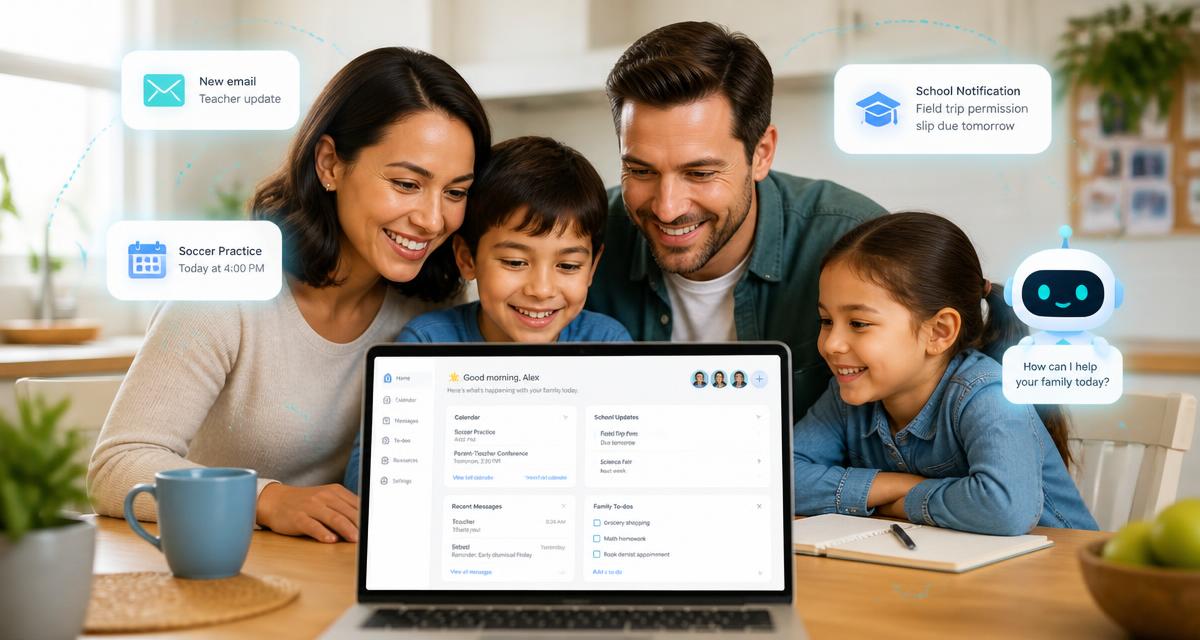
AI assistants are great at answering questions — until the answer lives inside seventeen different emails, a PDF permission slip, a calendar invite, and a link to a Google Doc that was updated twice.
If you have ever tried asking a generic AI agent, "What do I need to do for school this week?" you have probably gotten one of three answers:
- "I don't have access to your emails."
- A vague summary that misses the important detail.
- A confident answer that mixes up old and new information.
That is not the AI's fault. The information parents need is scattered, repetitive, and sometimes outright contradictory. ParentSync.io is built specifically to solve that. Here is how it works, and why it matters.
The real problem: school information is messy
Most families do not have one inbox for school. They have many:
- The main school newsletter
- Classroom updates from the teacher
- Principal announcements
- PTA emails
- Sports team schedules
- Club reminders
- Fundraising messages
- District-wide alerts
Each of these can arrive by email, calendar invite, or attachment. Some contain links to documents. Some are follow-ups that contradict the original message. Some are duplicates sent to both parents. And some are forwarded by a well-meaning friend three days after the fact.
If you ask a regular AI assistant to read all of that, it runs into a few hard problems:
1. Emails are not structured data
An email might say, "The field trip is Thursday, but if it rains we will move it to Friday and the permission slip is still due Wednesday." A human understands the nuance. A generic AI reading one email at a time often misses the conditional, the deadline, or the fact that the same trip was already mentioned in a previous message.
2. Links and attachments hide the real details
A message might contain a single sentence and a link to a Google Doc or PDF with the actual instructions. The AI has to follow the link, extract the text, and understand how it relates to the email. Most assistants stop at the email body.
3. Duplicate and conflicting messages create confusion
You might get the same field trip reminder from the teacher, the principal, and the PTA president. Each one has slightly different wording. One says the trip is at 9:00 AM, another says 8:45 AM. A generic AI might treat them as three separate events or pick the wrong time. You need a system that recognizes the duplicate, tracks the sources, and applies a simple rule: newer information wins.
4. Different messages mean different things to different kids
If you have more than one child, the same email might apply to one kid but not the other. A generic assistant does not know which child is in which grade, on which team, or enrolled in which club. Without that context, it cannot give you a useful answer.
How ParentSync.io solves this
ParentSync.io has three stages: ingest, process, and use.
Stage 1: Ingest — collect everything in one place
You connect your family's school email and calendars to ParentSync.io. That might mean:
- Forwarding school emails to your private ParentSync inbox
- Connecting a Google Calendar for each child's school, sports team, or club
- Letting the system pull in calendar feeds from activity websites
Once connected, ParentSync.io receives the same messages you do. Nothing gets lost in a forgotten inbox.
Stage 2: Process — turn noise into structured family knowledge
This is where the real work happens. ParentSync.io reads each email, follows links, extracts attachments, and parses calendar events. Then it uses AI to identify what actually matters:
- Events — field trips, concerts, parent-teacher conferences, practices
- To-dos — permission slips, forms, supplies, appointments
- Assignments — homework, projects, due dates, subjects
- Money matters — fees, dues, fundraising, payment deadlines
- Learning updates — what your child studied this week and conversation starters
- People — teachers, coaches, staff, and their contact information
It also understands context. It knows which child an email refers to, which school or activity it belongs to, and whether a message is a duplicate of something already seen. When two sources conflict, it keeps both sources but surfaces the most recent one.
Everything is stored as structured data, not just a pile of emails. That means the system can answer questions like:
- "What does Emma have due this week?"
- "When is the next soccer practice?"
- "How much do we owe for school activities this month?"
- "What did Liam learn about in class last week?"
Stage 3: Use — connect any AI agent through MCP
ParentSync.io exposes all of this organized information through an MCP layer. MCP is a standard way for AI agents to talk to tools. It means you can connect your favorite assistant — Claude, Cursor, or any agent that supports MCP — directly to your ParentSync.io account.
Instead of copying and pasting emails into a chat, your agent can ask ParentSync.io things like:
- "List my open to-dos for this week."
- "Show me upcoming events for the kids."
- "What assignments are due soon?"
- "Who are the teachers and coaches in our directory?"
The agent gets back clean, structured answers because ParentSync.io has already done the hard work of reading, understanding, and organizing the information.
Why this is different from just asking AI to read your email
You could give an AI assistant access to your inbox and ask it to figure things out. But without the structure ParentSync.io builds, the agent is starting from scratch every time. It has to re-read emails, re-follow links, re-guess which child a message is about, and re-resolve conflicts.
That is slow, expensive, and unreliable. It also means the agent cannot build a persistent picture of your family: who your children are, what activities they are in, which people matter, and what your weekly rhythm looks like.
ParentSync.io creates that persistent picture. It is a family operating system that any AI agent can query.
What this means for your daily life
The goal is simple: less time digging through messages, more time knowing what matters.
Instead of checking five different places to plan the week, you ask one question and get a real answer. Instead of missing a deadline because it was buried in a link, you see it clearly. Instead of both parents showing up at different times because they read different emails, you both see the same consolidated information.
And because the data is structured, it gets better over time. The more emails and calendars you connect, the smarter the picture becomes.
Ready to let AI actually help with school logistics?
If you are already using AI assistants but still feel like you are doing all the homework, ParentSync.io is the missing piece. It turns the fire hose of school communication into a calm, organized source of truth that any agent can use.
Sign up for ParentSync.io and connect your first school email or calendar. Your future self — and your AI assistant — will thank you.